The biomarker field in longevity now has a familiar problem: it is producing more interesting measurements than medicine yet knows quite what to do with. Epigenetic clocks can estimate biological age from DNA methylation. Proteomic models can predict mortality, multimorbidity and organ-specific risk from blood proteins. Imaging-based clocks can detect aging patterns in the brain, heart, liver and other organs. Yet even after several years of rapid progress, the field’s own consensus papers still say the same thing in different ways: no biomarker of aging has yet been clinically validated for routine use, and there is still no shared regulatory roadmap for how that validation should happen.
That does not mean all aging biomarkers sit at the same distance from real medicine. They do not. In 2026, the hierarchy is becoming clearer. Generic epigenetic clocks remain the field’s most visible and most widely used molecular tools, especially in trials and observational research. Proteomic biomarkers increasingly look stronger for near-term clinical risk stratification. Organ-specific biomarkers — especially proteomic and imaging-based ones — may be the most clinically legible of all, because they map onto questions physicians already ask about real organs and real disease. The answer, in other words, depends on what kind of “clinical use” one has in mind.
The first distinction is between clinical use, trial use, and scientific use
This matters because longevity discussions often blur three different jobs into one. A biomarker can be useful in science because it captures something real about aging biology. It can be useful in clinical trials because it helps stratify participants, monitor intervention response or generate early proof-of-biology. And it can be useful in clinical practice because it changes a medical decision in a way that improves outcomes. The 2024 Nature Medicine validation framework and the 2026 npj Aging recommendations paper both make this distinction indirectly: biomarkers of aging may help identify, evaluate and monitor interventions, but translation to the clinic requires much stronger evidence of comparability, predictive validity, longitudinal sensitivity and context-specific utility than the field currently has.
That is why the most honest answer to the headline is not “epigenetic” or “proteomic” alone. It is that different biomarker classes are closest to clinical use in different ways. The biomarker most useful in a phase 2 geroprotector trial may not be the one a clinician should use in ordinary practice. The tool that best predicts mortality across cohorts may not be the one most useful for tracking one organ system in a specialty clinic. Once that is clear, the current landscape becomes easier to read.
Epigenetic clocks remain the biomarker class most closely associated with modern biological aging. They are also, in some ways, the most mature. The 2026 npj Aging recommendations paper notes that first-generation molecular clocks were trained to predict chronological age, while second-generation clocks such as DNAm PhenoAge and DNAm GrimAge were trained more directly on mortality or health-related outcomes and are among the best predictors of mortality in the field. It also highlights a third generation of biomarkers designed to capture rate of aging, such as DunedinPACE, which are increasingly seen as especially relevant for intervention studies.
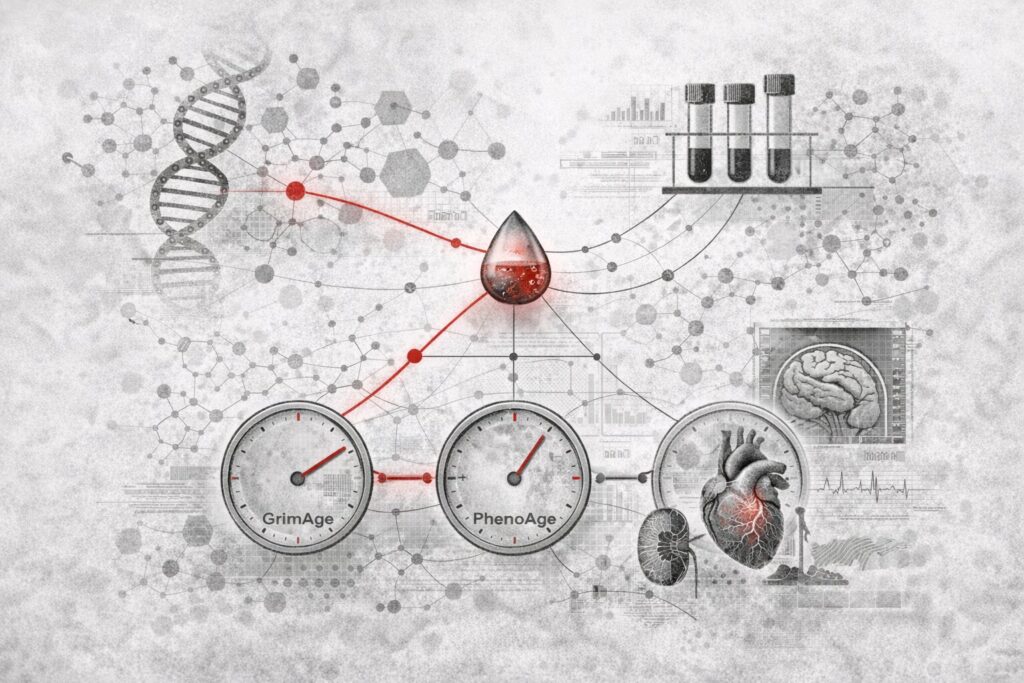
That makes epigenetic clocks unusually important for geroscience trials. The same recommendations paper explicitly says that rate-of-aging epigenetic biomarkers may be more sensitive to short-term interventions than some other classes, even if methylation biomarkers more generally may require longer intervals between measurements than proteomic markers do. That is a subtle but important point. Epigenetic biomarkers may not be the most dynamic clinical readouts, but they remain central because they offer a plausible way to connect intervention studies to aging biology over realistic human timescales.
Still, the epigenetic field’s visibility has probably made it look more clinically ready than it is. The 2025 essay “Do we actually need aging clocks?” argues that many clocks collapse complex risk information into a single biological-age number that can appear more actionable than it really is, and that direct health-outcome prediction may often be more useful than an abstract age estimate. Its authors draw a helpful contrast: some clocks compress biomarkers into a latent biological-age quantity, while others more directly aggregate predicted risks of disease and mortality. The latter may align more naturally with clinical use, but they also require large volumes of high-quality longitudinal data.
The most interesting recent epigenetic development is not another generic whole-body clock. It is the emergence of function-anchored clocks. In 2025, a Nature Aging paper described a blood-based DNA-methylation clock for intrinsic capacity, trained on cognition, locomotion, psychological well-being, sensory abilities and vitality. In the Framingham Heart Study, the authors reported that this intrinsic-capacity clock outperformed first- and second-generation epigenetic clocks in predicting all-cause mortality and linked more directly to functional, immunological and lifestyle measures. That matters because it gives epigenetics one of its clearest clinical narratives yet: not just “biological age,” but a molecular proxy for functional aging. Even so, that is still different from routine clinical validation.
So where do epigenetic clocks stand? Closest to clinical use in trials, not yet in routine care. They remain the field’s leading molecular tools for intervention studies, enrichment strategies and proof-of-biology. But the more generic the clock, the weaker the case that it should already drive ordinary clinical decisions. The strongest epigenetic clocks now look less like universal truth machines and more like specialized tools that become clinically interesting when tied to outcomes such as mortality, pace of aging, or intrinsic capacity.
Proteomic biomarkers may now be the strongest near-term candidates for risk stratification
If epigenetics still leads the field culturally, proteomics may now be its most clinically plausible molecular workhorse. One reason is conceptual: proteins sit closer to phenotype than methylation does. They reflect ongoing physiology, inflammation, metabolism, tissue stress and organ crosstalk more directly than upstream methylation signatures often do. Another reason is empirical. The 2024 Nature Medicine study on ProtAge found that its proteomic aging clock was a strong predictor of mortality and multimorbidity and associated with future risk of all 14 noncancer diseases studied and four common cancers, across diverse populations. The authors explicitly argued that plasma proteomics is a powerful tool for measuring biological age and identifying biological mechanisms involved in multimorbidity.
Proteomics also benefits from being more dynamic. The 2026 npj Aging recommendations paper says proteomic biomarkers may be more sensitive to short-term interventions, and recommends more frequent sampling for proteomic markers than for epigenetic ones because they can capture short-term dynamics better. That makes them especially attractive in early clinical development, where companies and researchers need signals that move on humanly manageable timelines.
Longitudinal work is making the case stronger. In 2025, Nature Metabolism published a nine-year longitudinal serum-proteome study covering 7,565 samples from 3,796 adults, identifying 86 aging-related proteins associated with 32 clinical traits and 14 major chronic diseases. The authors then built a 22-protein proteomic healthy aging score capable of predicting cardiometabolic disease incidence. This is exactly the sort of work that makes proteomics feel closer to practical medicine: not just a biological-age number, but a blood-based system that maps onto disease risk, modifiable biology and follow-up over time.
That does not make proteomics fully ready for routine longevity practice either. The field still lacks standardization, full benchmarking across platforms and regulatory-grade validation. But if the question is which molecular class looks most plausible for near-term clinical risk stratification, proteomics now has a strong case. It may be less famous than DNA methylation, but it is increasingly persuasive where medicine cares most: predicting disease, mortality and functional decline in ways that clinicians can recognize.
Organ-specific biomarkers may be the most clinically legible of all
The most important shift in 2025–2026 may be that the field is moving beyond generic whole-body aging measures toward organ-specific aging. This matters because medicine is still organized around organs and disease specialties, not around “aging” as one abstract whole. If a biomarker can say something meaningful about the aging trajectory of the brain, kidney, artery, heart or liver — and connect that to incident disease — it becomes much easier to imagine how it might enter practice.
This is where the newest proteomic work is especially striking. In 2025, Nature Aging reported organ-specific proteomic aging clocks developed in the UK Biobank and validated in cohorts from China and the United States. These clocks predicted disease onset, progression and mortality beyond clinical and genetic risk factors, with brain aging emerging as the strongest predictor of mortality. The authors also showed distinct organ-specific pathogenic pathways and argued that these clocks provide a biologically interpretable framework for tracking aging and disease risk across diverse populations. That is a much more clinically legible proposition than a generic age-gap score alone.
Imaging is pushing the same direction. A 2025 Nature Medicine paper on MRI-based multi-organ clocks notes that brain MRI–based aging clocks are already widely used as biomarkers of neurological aging, cognitive decline and neurodegenerative disease risk, then extends the idea to other organs including the heart, liver, spleen, adipose tissue, kidney and pancreas. Even here, “widely used” should not be confused with routine standard-of-care deployment. But among organ-specific biomarker concepts, brain age is clearly one of the most clinically familiar, and multi-organ imaging clocks are building on that foothold.
This is why organ-specific biomarkers may ultimately leapfrog more generic biological-age measures in real care. A clinician may not know what to do with a person who is “biologically 63.” But a neurologist, cardiologist or nephrologist can more easily reason about accelerated brain, arterial, or kidney aging if those measurements predict dementia, myocardial infarction, chronic kidney disease or mortality beyond standard risk factors. Organ specificity does not solve validation. It does make the path to use much easier to imagine.
So which biomarkers are actually closest?
The most defensible answer in 2026 is this: none are fully there yet, but the leaders differ by use case. For geroscience trials, epigenetic clocks — especially second-generation and rate-of-aging models — still look closest to usefulness because they are relatively mature, widely studied and already embedded in intervention logic. For near-term clinical risk stratification, proteomic biomarkers may now have the edge because they are dynamic, disease-linked and increasingly predictive across populations. For specialty clinical adoption, organ-specific proteomic and imaging biomarkers may be the most promising of all, because they connect aging to the organ-based decision structure medicine already uses.
That ranking also clarifies what is probably not closest: the generic consumer-facing promise that one whole-body biological-age number can already function as a broadly actionable clinical tool. The field is moving away from that framing, not toward it. The most promising biomarkers now are becoming more outcome-anchored, more organ-specific, more longitudinal and more explicit about context of use. That is a sign of maturity, not disappointment.
In other words, the future of clinical aging biomarkers may not belong to a single winner. It may belong to a layered system: epigenetic clocks for trial logic, proteomic panels for dynamic risk, and organ-specific biomarkers for actual clinical decisions. The field is not yet at routine longevity medicine. But it is no longer guessing in the dark about which path looks shortest.