For years, chronic inflammation sat in longevity science as both a familiar fact and a slightly unsatisfying explanation. Everyone knew it mattered. Older adults with more inflammation tended to fare worse. Frailty, cardiovascular disease, neurodegeneration, and multimorbidity all seemed to carry its fingerprints. But inflammation often felt like a downstream effect — a consequence of deeper damage rather than one of the field’s organizing principles. That has changed. In the 2023 update to the Hallmarks of Aging, chronic inflammation was elevated into the formal framework itself, and by 2025 a major Nature Aging review described inflammaging as a “pivotal convergence point” of multiple biological mechanisms involved in aging.
That does not mean inflammation has become a magic answer to aging. Serious researchers are not saying that every age-related decline can be reduced to cytokines. What they are increasingly saying is subtler and more important: chronic inflammation appears to sit at the junction where many different forms of biological wear, immune dysfunction, and failed repair begin to reinforce one another. In that sense, inflammation is moving to the center not because it explains everything, but because it connects so much.
From familiar byproduct to formal hallmark
The promotion of chronic inflammation into the hallmarks framework mattered because it codified a change that had already been building in the literature. The original 2013 hallmarks paper gave the field its first common map, but inflammation was not then listed as a standalone hallmark. By 2023, the revised Cell framework explicitly expanded the list to 12 hallmarks, adding disabled macroautophagy, dysbiosis, and chronic inflammation. That was more than a bookkeeping update. It signaled that inflammation had become too fundamental — and too well supported — to remain a side effect tucked inside other categories.
The reason is straightforward. Aging biology looks less and less like a stack of isolated failures and more like a dense web of feedback loops. The 2023 review Chronic inflammation and the hallmarks of aging argued that chronic inflammation has bidirectional relationships with the other eleven hallmarks and that their crosstalk creates a “vicious cycle” that worsens cellular decline and promotes aging. It went further, suggesting that drivers of chronic inflammation may be especially attractive translational targets precisely because they can amplify so many other hallmarks at once.
Why inflammation keeps moving inward
One reason inflammation keeps moving toward the center is that it is increasingly difficult to separate it from the other major mechanisms of aging. A 2022 JCI review described threads connecting cellular senescence, mitochondrial dysfunction, impaired mitophagy, and DNA damage as a kind of hub for inflammaging. A 2023 review in Signal Transduction and Targeted Therapy made the loop even clearer: senescent cells secrete inflammatory factors through the SASP, those inflammatory signals can induce more senescence, and chronic inflammation accelerates immune-cell aging, weakens clearance of senescent cells, and pushes organs toward dysfunction.
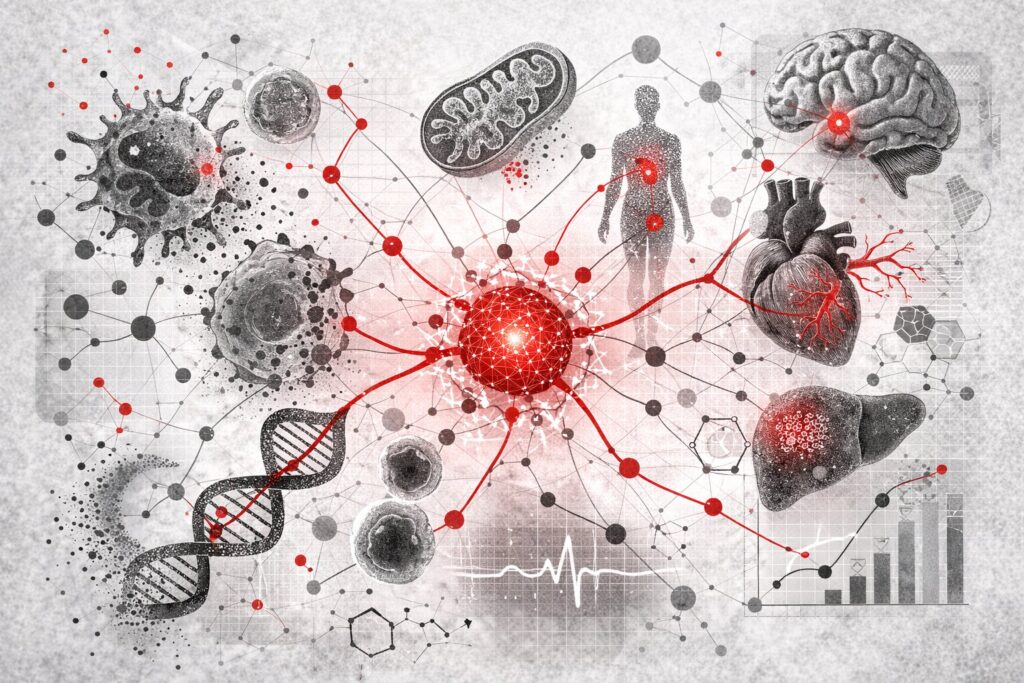
The same logic now extends into metabolism and immune aging. A 2025 review on immunosenescence and inflammaging described metabolic dysregulation, mitochondrial stress, insulin resistance, visceral adiposity, and damage-associated molecular patterns as major drivers of the chronic low-grade inflammatory state associated with aging. It also emphasized that immunosenescence and inflammaging form a feedback loop: one weakens immune resilience, the other sustains persistent inflammatory activation, and together they accelerate tissue dysfunction and age-related disease.
This is one reason inflammation has become such an attractive organizing concept. It links cell damage to immune dysfunction, metabolism to frailty, dysbiosis to systemic signaling, and tissue stress to organism-level decline. In the language of geroscience, it is one of the few processes that can plausibly connect molecular biology, organ pathology, and clinical aging without requiring the field to pretend aging has a single cause.
It also links biology to outcomes that matter
Inflammation has moved closer to the center because it is not just mechanistically rich; it is clinically legible. A 2024 transdisciplinary review described inflammaging as chronic, progressive, low-grade inflammation associated with frailty, disability, and death, and linked it to the pathogenesis of many age-related diseases. The same review argued that inflammaging has been implicated in rising multimorbidity and geriatric syndromes, which is exactly why it matters to clinicians and not just to bench scientists.
This clinical reach is part of what makes inflammation different from some other hallmarks. Widely measured inflammatory markers such as IL-1, IL-6, CRP, and TNF are associated with frailty, functional decline, cognitive decline, and mood disorders. They are imperfect, but they give the field a language for risk that feels closer to medicine than many abstract aging constructs do. If longevity science wants to influence real care — not just model organisms or philosophical debates — it has to care about mechanisms that map onto actual deterioration in function and resilience. Inflammation does that unusually well.
Measurement is pushing it inward too
Another reason inflammation keeps moving toward the center is that the field is trying harder to measure it as something more than a loose clinical impression. The 2025 Nature Aging review on precision interventions and metrics of inflammaging described inflammaging as a chronic, systemic, low-grade inflammatory state that is both a major risk factor for age-related diseases and a convergence point of aging biology. It also argued that the next step is not just to suppress inflammation generically, but to measure its heterogeneity, build inflammatory clocks, and understand how different lifelong exposures shape personalized aging trajectories.
That is important because inflammation is now being treated less as a generic bad state and more as a precision problem. The literature increasingly frames inflammaging as the result of genetics, lifestyle, socioeconomic conditions, infections, pollution, and other environmental pressures interacting over time. This does not weaken the case for inflammation. It strengthens it — by making it one of the places where biological aging and lived experience visibly meet.
But central does not mean universal
This is where the best current work becomes more interesting, not less. In 2025, a Nature Aging paper tested whether an inflammaging axis identified in the Italian InCHIANTI cohort generalized across a second industrialized population and two indigenous, nonindustrialized populations. It found substantial similarity in Singapore, but markedly different cytokine-axis structures in the Tsimane and Orang Asli, with little or no association with age and no association with age-related disease in those groups. The implication is not that inflammaging is fictitious. It is that the familiar form of inflammaging may be heavily shaped by industrialized environments and is not a universal human template.
That result is healthy for the field. It forces researchers to be more precise about what they mean when they say inflammation rises with age. It also protects longevity science from one of its recurring temptations: mistaking an important mechanism for the mechanism. Chronic inflammation may be central, but it is also heterogeneous, context-dependent, and intertwined with immune aging, infection history, metabolic status, and social environment. A serious field should be able to hold all of those ideas at once.
The therapeutic promise is real — but so are the limits
Inflammation is also moving to the center because it looks actionable. The transdisciplinary review on inflammaging noted that anti-inflammatory therapies are increasingly being studied as potential anti-aging treatments and that clinical trials have shown benefits in selected age-related diseases. It also pointed to a wider therapeutic menu that includes senolytics and inhibitors of pro-inflammatory cytokines. That helps explain why inflammation has become attractive not just as a theory of aging, but as a development target.
Still, the limits are just as important as the promise. The same review is careful that widely used inflammatory markers do not reveal the cause of inflammation and do not reliably predict when someone will transition into frailty or multimorbidity. It also points out that an IL-1β inhibitor reduced cardiovascular events in one context but did not lower incident frailty over five years in a post hoc analysis — a useful reminder that reducing one inflammatory pathway is not the same as solving the broader biology of aging. Inflammation is central partly because it is shared, but that also makes it hard to treat with single, elegant moves.
What the field is really saying
So why does chronic inflammation keep moving to the center of longevity science? Because it sits where the field’s three biggest needs increasingly overlap: mechanistic integration, clinically meaningful outcomes, and translational actionability. It is one of the few concepts that can connect senescent cells, immune aging, metabolism, microbiome disruption, frailty, and multimorbidity without collapsing into a slogan. And unlike many alluring ideas in longevity, it already has one foot in real medicine.
The danger, of course, is overcorrection. If the field starts talking as though inflammation is the master variable behind all aging, it will repeat an old longevity mistake: turning a powerful framework into a monocausal story. The stronger reading is more disciplined. Chronic inflammation is moving toward the center because it behaves less like a side effect and more like a systems-level amplifier of aging. That is not the whole map of longevity science. But it is increasingly one of the places where the map becomes easiest to read.