Longevity companies often talk as if their advantage lies in a proprietary clock, a sharper scan, a larger omics panel, or a more elegant algorithm. Those things matter. But they may not be the deepest advantage in the field. The harder, slower, and potentially more durable asset is not a single test. It is longitudinal data: repeated measurements from the same people, over time, linked to meaningful changes in health, function, disease, and response. The scientific case for that is already quite strong. A 2024 review on validating biomarkers of aging argued that repeated measures from the same participants provide the best approximation of the “pace of aging,” while a 2025 Cell review on precision geromedicine framed the future of the field around high-dimensional clinical, molecular, and digital biomarkers tailored to individual trajectories rather than static averages.
That point sounds technical, but it cuts across almost every argument in longevity. If aging is a process rather than a moment, then a one-time reading can only tell you so much. A blood draw, scan, or epigenetic estimate may offer a snapshot. It may even be a useful one. But the field’s central promise is not to describe a person once. It is to understand how that person is changing, how fast risk is accumulating, whether an intervention altered that path, and how those trajectories differ across individuals, organs, and environments. That is why longitudinal data increasingly looks less like a supporting asset and more like the core infrastructure of serious longevity science.
A snapshot is not a trajectory
The biomarker-validation literature has become unusually clear on this point. The 2024 review notes that many early aging biomarkers were developed from cross-sectional datasets because those were more readily available and were good at identifying associations with chronological age. But it also stresses that cross-sectional studies come with a major limitation: they provide only a snapshot in time, can be biased by secular trends and selective participation, and cannot assess within-individual change in response to interventions. The authors say that this sensitivity to change is a key requirement for using biomarkers of aging in clinical trials. In plain language, a test can correlate with age and still be weak at telling you whether someone is aging faster, slower, or differently than before.
That is one reason the field has gradually shifted from asking, “Can we estimate biological age?” to asking, “Can we measure the rate at which biological aging is unfolding?” The distinction is not semantic. A static biological-age estimate may be informative, but a pace-of-aging measure is closer to what intervention science actually needs. If a company claims to slow aging, the relevant question is not only what number a customer gets today. It is whether repeated measurements show a different trajectory tomorrow, next year, and across longer follow-up. That is the kind of evidence regulators, clinicians, and serious investors are more likely to trust.
The best-known clocks already depend on longitudinal science
Some of the field’s most influential biomarkers make this dependency explicit. DunedinPACE, one of the best-known pace-of-aging measures, was not built from a generic age-prediction exercise alone. It was derived from a birth cohort followed for two decades, using within-individual decline in 19 indicators of organ-system integrity across four time points to model the pace of aging, then distilling that into a single-time-point DNA-methylation measure. The paper argues directly that what geroscience needs is a way to measure each trial participant’s personal pace of biological aging before, during, after, and at long-term follow-up to determine whether a geroprotective therapy actually slows that pace.
That origin story matters more than the brand name of the clock itself. The strongest single-number biomarkers in aging often derive their credibility from years of repeated phenotyping beneath the surface. The number may look simple at the point of use, but the science behind it is longitudinal. In that sense, the field’s most sophisticated biomarkers are not really shortcuts around long-term follow-up. They are compressed expressions of long-term follow-up.
The field is moving from isolated markers to longitudinal systems
You can see this shift in newer studies as well. A 2025 Nature Metabolism paper mapped the longitudinal serum proteome in 7,565 samples from 3,796 middle-aged and older adults across three time points over nine years. The authors identified 86 aging-related proteins linked to 32 clinical traits and the incidence of 14 major age-related chronic diseases, then used 22 of those proteins to build a proteomic healthy-aging score that predicted cardiometabolic disease risk. The notable part is not just that proteins were predictive. It is that the authors emphasized that these markers are rarely validated longitudinally, and then built precisely that kind of longitudinal map.
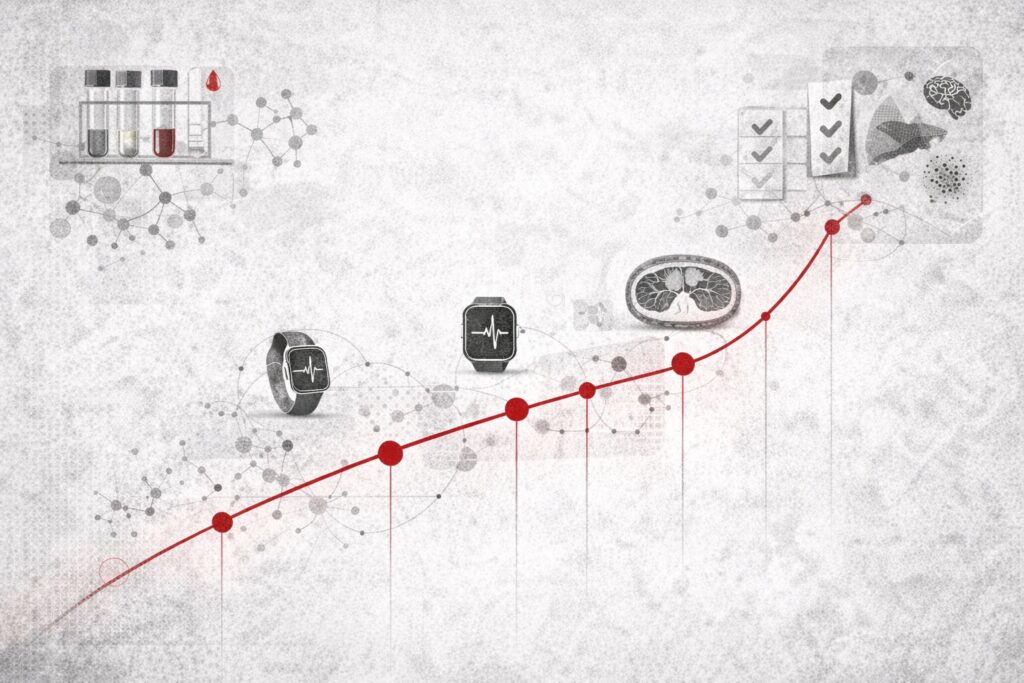
The same logic is pushing into digital biomarkers. A 2025 Nature Communications paper described PpgAge, a wearable-based aging clock using wrist photoplethysmography from the Apple Heart & Movement Study, spanning more than 149 million participant-days. The authors argue that wearables matter because, unlike many clinical biomarkers gathered only at discrete visits, they can generate frequent and inexpensive measurements throughout daily living. In that study, PpgAge was associated with disease and behavior, predicted incident heart disease events, and showed sharp longitudinal changes during pregnancy and around certain cardiac events. That is not just a new clock. It is a sign that the field is beginning to care as much about continuity of measurement as about the biomarker modality itself.
A related move is visible in the 2025 Health Octo Tool paper. Rather than force aging into one metric, the authors used longitudinal data from BLSA, InCHIANTI, and NHANES to examine disease severity across 13 organ systems, generating tools that combine organ-system burden, walking speed, disability, and aging rates. The paper argues that aging is multidimensional and cannot be captured by a single metric, and presents the Health Octo Tool as a framework for tracking heterogeneity across organs and individuals. That is an important clue to where defensibility may lie. The more the field accepts that aging is heterogeneous, the more valuable repeated, multidimensional data becomes.
Why this matters for business, not just biology
This scientific shift has a commercial consequence. A one-time test can be a product. A repeated measurement relationship can become a platform.
That is one reason some of the most closely watched companies in preventive health are built around recurrence. When Neko Health announced its $260 million Series B in 2025, it said it had completed 10,000 scans, had a waiting list of more than 100,000, and, notably, that 80% of members book and prepay the following year’s scan at the end of their appointment. That is not merely a customer-retention statistic. It points to a business model in which the value compounds through repeated observation. A scan is useful; a second and third scan begin to create a trajectory.
This is where the word moat becomes more interesting than it first appears. In many sectors, data alone is not a moat because raw data is messy, abundant, and easy to overrate. In longevity, however, standardized longitudinal data linked to real outcomes may be unusually defensible because it is hard to build quickly. It requires time, retention, consistent protocols, careful follow-up, and enough clinical or behavioral context to interpret change. A competitor can copy a panel. It is much harder to copy years of repeated observations tied to downstream outcomes and intervention responses. That is partly an inference, but it follows directly from what the validation literature says the field actually needs.
Precision geromedicine depends on exactly this kind of data
The 2025 Cell review on precision geromedicine makes the broader trajectory explicit. It argues that new molecular profiling technologies are enabling the characterization of pathways that can serve as biomarkers of aging, and anticipates a future in which gerotherapeutics are tailored using a mix of genetic profiles, high-dimensional omics-based biomarkers, clinical and digital biomarkers, psychosocial information, and past or present exposures. That is a powerful vision, but it quietly assumes something difficult: those data layers must be linked across time in a way that supports interpretation and intervention. A one-off omics snapshot is interesting. Precision care requires a story about movement.
The same assumption appears in the 2025 recommendations paper on biomarker data collection for longevity biotechnology companies. It argues that standard practices are needed so clinical trials can support parallel and ongoing validation and benchmarking efforts for aging biomarkers, and emphasizes that biomarkers can help stratify participants, prioritize interventions, and monitor response. It also highlights digital biomarkers because, unlike many biospecimen-based measures, they can support continuous monitoring of heart rate, sleep, and activity. That is not just a methodological recommendation. It is effectively a blueprint for where value in longevity data may accumulate.
Not all data is a moat
Still, the word should be used carefully. Not every company sitting on lots of health data has built a defensible asset. Data exhaust is not the same thing as a learning system.
The validation literature is full of warnings here. The 2024 biomarker review notes that there are still no recommended regulatory guidelines standardizing the development and validation of aging biomarkers, and that clinical usefulness remains contested. The 2025 recommendations paper similarly says that no biomarker of aging has yet been clinically validated, even though the field has made significant progress. That means volume alone is not enough. A company can collect huge amounts of data and still fail to generate something that is comparable across populations, useful within individuals, or predictive of outcomes that matter.
So the real moat, if it exists, is narrower than “having data.” It is having high-quality, standardized, repeated, multimodal, outcome-linked data collected in a way that lets a company or research group learn faster than others. It is the difference between selling a biological-age number and building the infrastructure to understand whether that number changes in a valid way, for whom, under what interventions, and with what clinical consequences. In longevity, the companies and institutions that win may not be those with the flashiest biomarker. They may be the ones that can most credibly connect biomarker change to longitudinal human reality.
The real lesson
Longevity has spent years talking as if the prize were a magic clock or a master intervention. The field now looks more like an exercise in trajectory-building. Biomarkers are getting better. Wearables are getting richer. Multi-omic and organ-specific models are becoming more sophisticated. But the common thread across the most serious work is not novelty alone. It is repeated measurement over time, anchored to disease, function, resilience, and response.
So why might longitudinal data be the real moat in longevity? Because aging is not a still photograph. It is a moving process. Any company, clinic, or platform that hopes to understand it — let alone change it — will eventually need more than a snapshot. It will need a durable record of how people change, how interventions land, and how biological signals connect to lived outcomes. In longevity, that may be the deepest asset of all.